Two Buildings, One Lens: Tokina 11-18mm
Tokina atx-m 11-18mm F2.8
Architecture in Seville
Architecture photography is often described as a technical discipline. The right time of day. The correct corrections. Clean verticals. Controlled distortion.
That is all true. But before any of it, there is a more fundamental question: does the lens understand the building?
Not every wide-angle lens thinks the same way. Focal length determines what fits in the frame. But how a lens handles proximity, layers, depth, and edge behaviour determines what the image actually feels like. That character becomes the real working relationship between photographer and tool.
In Seville, I used the Tokina atx-m 11-18mm F2.8 across two buildings that could not be more different. Plaza de España is one of the great ornamental structures of the twentieth century; layered, curved, dense with detail. Las Setas, formally known as the Metropol Parasol, is a contemporary timber lattice structure that rises above the old city like something from a different century entirely.
The same lens. Two completely different problems. Two completely different conversations.

Plaza de España, Seville. Tokina atx-m 11-18mm F2.8 | Sony A7IV. 14mm
Plaza de España: Managing Depth and Ornament
Plaza de España was built for the 1929 Ibero-American Exposition. It is a semicircular complex of brick, marble, and tilework; colonnaded galleries curving away on both sides, twin towers anchoring each end, a moat and bridges completing the enclosure. At ground level, it is overwhelming in the best possible way.
The challenge with a building like this is not scale. It is layers.
An ultra-wide lens in the wrong hands at a location like this produces an image that contains everything and communicates nothing. Arches in front of arches in front of more arches. Ceiling detail fighting floor detail. The eye has nowhere to land.
The atx-m 11-18mm handles this differently than I expected.
At 11mm, the compression of near and far is aggressive. Moving close to a foreground column and pointing into the colonnade produces extreme recession; arches diminishing rapidly, ceiling tiles stacking into the distance, the far end of the gallery becoming a vanishing point that pulls the viewer through the frame. The depth feels architectural rather than distorted. The building's own logic takes over.


Plaza de España, Seville. Tokina atx-m 11-18mm F2.8 | Sony A7IV. 11mm
Plaza de España, Seville. Tokina atx-m 11-18mm F2.8 | Sony A7IV. 18mm
Small shifts in position changed the image dramatically, a half-step left or right altered the foreground anchor, the background framing, the way the floor tiles read against the ceiling. The lens rewarded that precision. Edge sharpness held consistently across positions, which meant every compositional decision landed exactly as intended.

Plaza de España, Seville. Tokina atx-m 11-18mm F2.8 | Sony A7IV. 16mm
Inside the colonnaded galleries, the interior ceiling held warm reflected brick tones while the exterior view through each arch sat considerably brighter. The lens handled that dynamic range cleanly, consistent rendering from deep shadow through to bright exterior, with detail retained across the full frame.

Plaza de España, Seville. Tokina atx-m 11-18mm F2.8 | Sony A7IV. 14mm

Plaza de España, Seville. Tokina atx-m 11-18mm F2.8 | Sony A7IV. 16mm
Las Setas: Geometry, Repetition, and Scale Against Sky
Las Setas presents a completely different challenge to work with.
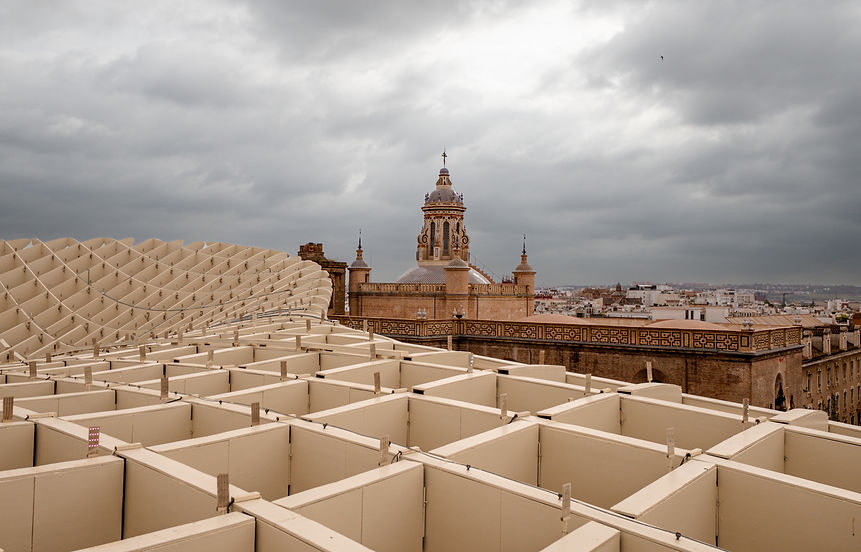
Where Plaza de España gives you centuries of refined detail, Las Setas gives you structure. The Metropol Parasol is the largest timber structure in the world; a series of undulating canopy forms supported on concrete columns, with a raised walkway running along the top. From the ground, it reads as organic and flowing. From the walkway level, it becomes something else entirely: a grid of repetitive wooden modules extending in every direction, the old city of Seville visible in every gap.

Las Setas from ground level. Scale becomes the first language. Tokina atx-m 11-18mm F2.8 | Sony A7IV. 11mm
An ultra-wide lens at height, surrounded by a repeating geometric pattern, faces a specific test: does the distortion add energy to the repetition, or does it make the image feel uncontrolled?
At 18mm on the walkway, the curvature of the structure became a compositional element. The atx-m rendered the sweeping curve of the walkway railing as a strong leading line through an otherwise dense field of modules. That required precise placement, too close to the railing and it dominates; too far and it loses its rhythm. The wide field of view meant small position changes had significant compositional consequences, which kept the shooting process active.

The walkway as leading line, Seville's skyline as counterpoint. Tokina atx-m 11-18mm F2.8 | Sony A7IV. 18mm
What the lens did well here was maintain geometric coherence in the mid-frame. The grid of timber modules did not bow or warp in ways that read as optical error. The repeating rectangular forms remained recognisable as rectangles. Edge distortion was present but manageable and, in this context, appropriate, a structure this dynamic benefits from some visual tension in the frame.

Old Seville through the contemporary lattice. Tokina atx-m 11-18mm F2.8 | Sony A7IV. 11mm

The grid at close range. Tokina atx-m 11-18mm F2.8 | Sony A7IV. 11mm
The relationship between the contemporary structure and the historic Seville skyline visible beyond it was the real subject. Churches, towers, rooftops; all of it compressed into a narrow band of background behind the lattice. At this focal length, that background reads as a counterpoint rather than a distraction. The lens made the contrast between old and new legible, which is what the building itself is about.

Old Seville through a contemporary frame. Tokina atx-m 11-18mm F2.8 | Sony A7IV. 11mm
The aperture of F2.8 was not used here for depth of field. At architectural distances, everything is sharp regardless. It mattered for the overcast conditions, allowing a shutter speed fast enough to avoid any camera movement introducing softness into the fine structural detail. This is where the F2.8 constant aperture pays for itself practically rather than just on paper.

The full sweep of the structure. Reach without distortion drama.. Tokina atx-m 11-18mm F2.8 | Sony A7IV. 11mm
Las Setas: Geometry, Repetition, and Scale Against Sky
A single location is not a test. Any competent wide-angle lens can perform well under ideal conditions at a single iconic building.
The value of shooting two buildings as different as Plaza de España and Las Setas with the same lens is that the lens's character becomes visible under contrast. What it does consistently. Where it adapts. What it asks of the photographer.
The atx-m 11-18mm is consistent in the mid-frame across both locations. The central rendering quality I relied on at Plaza de España to resolve ceiling tile detail was the same quality I relied on at Las Setas to keep timber module geometry coherent. That consistency is not a small thing, it meant I could trust the lens rather than manage it.
It is demanding at the wide end in the way any 11mm focal length is demanding: position matters enormously, and the lens will not correct for poor placement. But it does not add optical complexity to compositional complexity. When the framing is right, the lens supports it cleanly.
It is genuinely useful at 18mm in a way that some ultra-wide zooms are not. Many lenses in this range treat 18mm as an afterthought. The atx-m uses it. The range between 11 and 18mm is a working range, not a transition between one strong focal length and a compromise position.
For architectural work, that range matters. A building as contained as Plaza de España's colonnades and a structure as expansive as Las Setas require different focal lengths. Being able to move between them without changing lenses, without breaking the rhythm of reading the building and finding the frame, kept the shooting process fluid.
Two buildings, one lens. The rendering remains consistent across both. Tokina atx-m 11-18mm F2.8 | Sony A7IV. 18mm
Practical Notes
Shooting format:
RAW throughout. Architectural work requires the latitude for fine control of highlights and shadow recovery, particularly when interior and exterior exposures are in the same frame.
Editing approach:
Restrained. The lens's rendering responds best to minimal corrections; modest clarity, careful contrast, retained blacks. Over-processing architectural images with strong geometric content produces an artificial quality that undermines what was achieved in the field. Lens profile corrections were applied, but kept conservative.
When to use F2.8:
Not primarily for shallow depth of field at architectural distances, but for maintaining shutter speed and ISO discipline in challenging light. Overcast Seville provided consistent but low-intensity light. The constant F2.8 removed one variable from exposure decisions.
Movement and timing:
Architecture is not static in the way it might appear. Light shifts. People enter and exit the frame. Reflections change. The 11-18mm range rewards patience, arriving at a position that works compositionally and then waiting for the frame to complete itself is often more productive than adjusting the lens constantly.
Seville is one of the most photographed cities in the world. Both of these buildings have been shot thousands of times.
The question is always what a particular lens, handled in a particular way, brings to a location that has already been seen. The atx-m 11-18mm brought precision at the wide end, genuine quality at 18mm, and consistent mid-frame rendering across two buildings that asked completely different things of it.
That is what I look for in a working lens. Not a lens that performs impressively in one situation, but one that thinks clearly across multiple situations. One that allows the building to lead.

All images shot on Sony A7IV with the Tokina atx-m 11-18mm F2.8.
Seville, Andalucía, Spain.


