Chasing the Moon Across London
A Season with the Tokina Reflex Lenses
Astrophotography is usually described as something that happens far from cities: dark skies, remote locations, hours of driving to escape light pollution. Almost none of this project happened that way. Most of it happened in London.
That constraint changed the question I was actually answering. Not "how do I find a dark enough sky," but "what can this lens do with the sky I actually have."
I used the Tokina Reflex 300mm and 900mm across two very different versions of the same subject. One was the moon still sharing the sky with daylight, sitting alongside planes, birds, and rooftop silhouettes. The other was the moon alone in full darkness, with nothing left in the frame to compete with it.
Same lenses. Same subject, technically. Two completely different scenes.

Tokina Reflex | Sony A7IV. 900mm
Moon Alone: Detail Without Distraction
The starting point was the moon with nothing else in the frame. No foreground, no context, just full dark and the question of how much of the lunar surface I could actually resolve.
This is where the reflex design shows its character very clearly. Against a dark sky, with not much competing light source, the lens's rendering of the moon, the line between lit and shadowed lunar surface, held genuine crater detail rather than flattening into a soft grey disc. Manual focus, checked with magnification rather than trusted by eye, was non-negotiable here. At 900mm, the margin between "sharp" and "almost sharp" is thin, and against pure black there is nowhere for softness to hide.

Tokina Reflex | Sony A7IV. 900mm
A single frame rarely told the full story. Working the same dark sky across several sessions, at slightly different phases and angles of light, was the only way to know the 900mm's resolving power consistently rather than by luck on one good night.
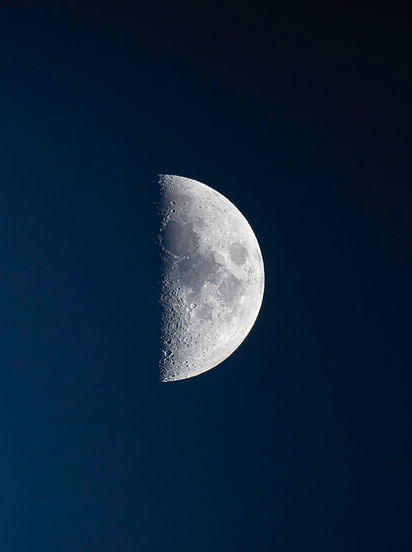
Tokina Reflex | Sony A7IV. 900mm

Tokina Reflex | Sony A7IV. 900mm
Moon in Daylight: Managing Composition
In blue hour and late afternoon light, the moon is rarely alone. There is always something else in the sky asking for attention: an aircraft crossing the frame, gulls moving through, a spire or an architectural ornament catching the last of the light.
The challenge here is not finding the moon. It is deciding what the moon is in conversation with.
At this focal length, a plane crossing well above or below the moon reads as incidental unless the timing and spacing are deliberate. Waiting for a flight path to intersect the moon's position, rather than accepting whatever happened to pass overhead, was the difference between a coincidence and a composition.
The same was true working around the spires and rooftop ornaments that gave the moon something architectural to sit against, but only from specific positions and at specific moments in its rise.


Tokina Reflex | Sony A7IV. 300mm
Tokina Reflex | Sony A7IV. 300mm

Tokina Reflex | Sony A7IV. 300mm
A single lighting condition is not a real test of a lens. Anything performs well against an easy version of its subject. Shooting the moon isolated and exposed at night, then crowded and busy at dusk, showed where the Reflex range was consistent and where each focal length earned its specific use. All resolved the moon cleanly. What changed was everything I had to manage around it.

Tokina Reflex | Sony A7IV. 300mm

Tokina Reflex | Sony A7IV. 300mm
Practical Notes
Shooting format: RAW throughout. The dynamic range between the lit moon and a darkening sky, or between the moon and a foreground silhouette, needed the latitude to protect highlight detail without losing the rest of the frame.
Editing approach: Restrained. Sharpening concentrated on the terminator, not the whole disc. Denoise applied carefully where ISO was raised to protect shutter speed, while protecting the lunar surface itself.
Manual focus: Confirmed with magnification every time, not assumed from the rear screen. This mattered most at 900mm, where the margin between sharp and almost sharp is thin enough to disappear if trusted to the eye alone.
Timing: Careful attention to moonrise timing and position on any given night, checked against atmospheric conditions, since haze near the horizon can undo an otherwise correct alignment.
London is not known for astronomical clarity. The question was always what a specific lens, handled with intention, could do with a challenging sky. The Reflex range brought total resolution at 900mm, controlled composition at 300mm, and consistent rendering across two conditions that asked very different things of it.
That is what I look for in a working set of lenses. Not one that performs well in ideal conditions, but one that holds its character when the conditions vary.

All images shot on Sony A7IV with the Tokina Reflex Lenses.
London, United Kingdom.


